
Research: London’s BIDs are vital contributors to reducing low-level crime

Research: London’s BIDs are vital contributors to reducing low-level crime
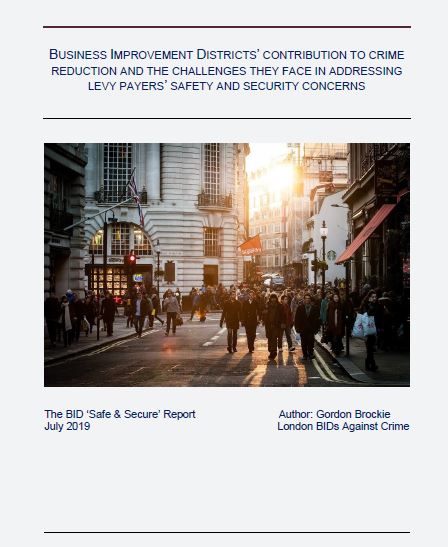
New research released by London BIDs Against Crime (LBAC) assesses the contribution of London’s Business Improvement Districts to crime-reduction across the capital, and identifies the challenges they face in addressing levy payers’ safety and security concerns.

Here are some of the key findings of the report:

  • BID consultation feedback gathered from business communities across the capital clearly demonstrates that ‘safe and secure’ issues consistently rate amongst the top concerns for levy payers.
  • Not only do the majority of BIDs have the solid foundations of a Business Crime Reduction Partnership embedded into their ‘safe and secure’ models, the overall benefits they deliver far exceed traditional town centre approaches to crime reduction.
  • London BIDs are a valuable partner in raising counter terrorism awareness across the capital’s business communities due to their outreach and high levels of business engagement.
  • Government cuts, a reduction in policing numbers, an upsurge in violent crime and changing policing priorities are all factors that leave BID operating areas and the very heart of our town centre communities vulnerable to crime, antisocial behavior and a downturn in economic prosperity.
  • Against the backdrop of their own austerity measures and equally affected by policing cuts; national retailers are increasingly looking for a greater return on their levy fees through additional levels of BID security investment.

Highlighting the substantial impact BIDs have on preventing and detecting business crime and antisocial behaviour in the communities they serve, the report also critically examines the roles of partnerships across the private and public sector and makes achievable recommendations on how key partners and all stakeholders involved in crime reduction can collaborate to make BIDs safer places to work, visit and invest in, these include:

  • BIDs should clearly document their financial ‘safe and secure’ commitment within their business plan as well as defining what crime reduction measures are being delivered on their website.
  • BIDs should consider introducing a more uniformed approach to their crime reduction schemes by adopting the nationally recognised BCRP framework into their ‘safe and secure’ models or out-sourcing their BCRP to a specialist third party.
  • National retailers are encouraged to introduce head office policies to support BID security initiatives in their local stores, covering direct participation in these schemes, the use of local town-link radios and active participation in BIDs’ Disc systems.
  • NBCC and Met Police should define standard operating procedures to ensure a consistent quality of service is delivered to businesses and the public in town centres – this message must be communicated effectively to on-the-ground BID-funded police officers and officers with town-centre beats.
  • MOPAC should issue guidance of best practice on how local authority community safety teams can work in partnership with BIDs to meet their shared objectives.
  • The Home Office should increase its funding and commitment to the NBCC to benefit all stakeholders involved in business crime-reduction locally, force-wide and nationally.

Report author, Gordon Brockie says

“In addition to the positive findings and survey results, I was impressed to discover that many BIDs were taking a more holistic approach to tackling business crime by acknowledging how societal issues such as knife crime, hate crime, violence against women and offences against the vulnerable impact their own business communities. I was also surprised by the quality of business resilience support being delivered in central and inner London BIDs.

“I’m pleased to see some of the recommendations of the report are already taking shape and that more integrated ties have been established between London BIDs and the Metropolitan Police, Mayor’s Office for Policing and Crime and London Councils. Although significant progress is being made, it’s anticipated that questions around statutory levels of responsibility will still remain an interesting area of debate.”
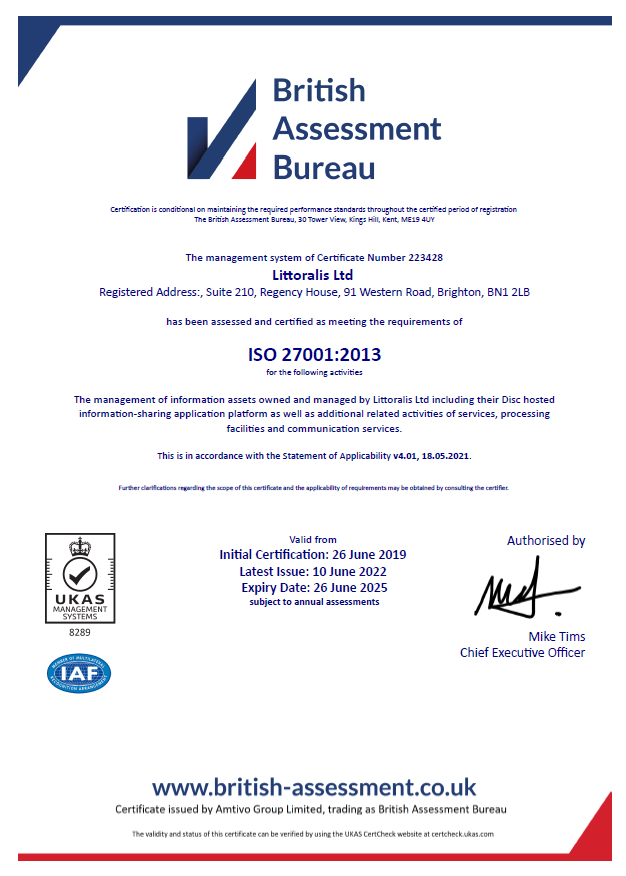

Littoralis, the company behind Disc, awarded ISO27001 certification

Littoralis, the company behind Disc, awarded ISO27001 certification

We are hugely proud to have been awarded ISO27001 certification – the highest, most demanding certification in the field of information security management. IT companies increasingly seek ISO27001 certification for their own operations, and larger non-IT companies increasingly require their IT service providers to show that they are certified.

The ISO27001 certification covers Littoralis itself, and our Disc crime management system which is used throughout the country by a variety of crime reduction organisations for sharing information about offenders as well as current awareness among Disc members, and direct-to-police crime reporting.  It confirms that Littoralis applies the highest standards of information security throughout its organisation.

Disc is a unique crime information-sharing system that’s helping drive down low-level crime and antisocial behaviour (ASB) in more than 450 towns and cities across the UK. It empowers communities to ‘self-manage’ low-level crime and ASB, and enables police to work with them to deliver a new kind of effective, joined-up community policing. Each Disc implementation can link together into flexible networks to exchange crime and offender information locally, regionally or nationally.

Chief Executive of Littoralis, Charlie Newman explains “Compared with the types of organisations that usually achieve ISO27001 certification, we’re ridiculously small – so we’re really proud to have achieved ISO27001 certification within five months of the project being started. Big congratulations to Dave Jackson who led this project in-house for us, and thanks also to Aston InfoSec for their invaluable guidance”.

West Mercia Police launches Disc across Telford

West Mercia Police launches Disc across Telford

West Mercia Police, with the support from their Police & Crime Commissioner John Campion, have invested in more Disc systems for the Telford area.

The latest system is support Madeley Town centre and joins stand-alone systems currently operating in Telford itself, Oakengates, Wellington and Dawley.

Disc is a unique crime information-sharing system that’s helping drive down low-level crime and antisocial behaviour (ASB) in more than 500 towns and cities across the UK. It empowers communities to ‘self-manage’ low-level crime and ASB, and enables police to work with them to deliver a new kind of effective, joined-up community policing. Each Disc implementation can link together into flexible networks to exchange crime and offender information locally, regionally or nationally.

Alexander Footman and his successor in post, Berwyn Pratt, have now overseen the implementation of a total of six Disc systems each deployed across a town in the Telford area.

Charlie Newman, Chief Executive of Littoralis says, “This is a great and effective way to deploy Disc across smaller towns. Using a single implementation to support individual  local crime reduction schemes not only brings professional levels of management but also ensures that all-important data protection obligations are complied with.”

He continues, “This latest roll-out of the Disc system means that there are now no less than 14 Disc systems at work across the West Mercia policing area, the largest rural force in England & Wales.  They join existing dual systems in Hereford, Shrewsbury and Oswestry, as well as the stand-alone systems in Bromsgrove, Worcester and  the six systems across Telford .  That’s a great achievement…congratulations to everyone involved!”

National Business Crime Solution chooses Disc to help members fight retail crime

National Business Crime Solution chooses Disc to help members fight retail crime

Disc is proud to have been selected as the online current awareness platform for the National Business Crime Solution (NBCS) and to play a key part in its services, not only to its members, but also to BIDs and other crime reduction schemes around the country.

NBCS enables the effective sharing of appropriate data between major retailers, the police and crime reduction schemes, and proactively targets criminality to reduce crime and risks to all. The not-for-profit organisation is funded by most of the major retailers in the UK.

Disc is delivering NBCS alerts to its members about travelling shoplifting ‘teams’, suspicious vehicles, ram-raiders, fraudsters and more. It helps NBCS send this valuable information to its members fast – the quicker it’s communicated the sooner they can protect themselves and their staff. It also provides NBCS with a simple, accessible yet powerful way to share its in-depth analysis, which helps not only protect against the impact of crime, but also assists in identifying offenders and bringing them to justice.

The information that NBCS provides to its members often contains personal data relating to known and unknown offenders. With its robust security provision and alignment with the key GDPR concept of ‘data protection by design and by default’, Disc is uniquely suited to the job. The system is already used by local retail crime reduction schemes in more than 450 towns and city-centres across the UK. For those BIDs who are themselves using Disc, alerts from NBCS can be automatically sent straight into their Disc Admin Centres so that sharing them with their members is a matter of a single mouse-click.

Charlie Newman, Chief Executive of Littoralis (the company behind Disc) explains “We have always been super-keen advocates of the NBCS. It’s always been obvious that a national information sharing system that links up retailers and police efficiently, means that both of them will become more effective in reducing business crime. It’s also obvious that local business crime partnerships have a great deal to gain from – and give to – such a scheme, and we’re proud to be helping build a closer, mutually supportive relationship between them.

“Looking ahead, we have a vision of the future which I believe aligns with NBCS’s. We’re delighted that they have put Disc at the heart of their business – but there is so much more that can be achieved and we’re looking forward to working with them on more exciting projects going forward!”

Disc’s crime reporting system tackles Hereford’s low-level crime

Disc’s crime reporting system tackles Hereford’s low-level crime

In early 2015, businesses and property owners voted to establish a Business Improvement District (BID) for the City of Hereford, with the principle aim of delivering investment and improvement to the commercial area.  Hereford BID signed up to Disc, the online crime reporting system and digital app, and with many local businesses continuing to sign up, the organisation says the area has never felt safer.

Disc is enabling retailers to be more vigilant in looking for criminal behaviour and the number of users is rapidly increasing. With an increase of 31% since January 2019,  more local businesses are actively helping to identify and report individuals involved in low level crimes such anti-social behaviour and the usage of fake currency.  With fake notes being commonly used by criminals to pay for small value items to gain genuine currency in change or to buy large value items which get sold on, it is a problem that many businesses face and one which can have a big impact on the profitability of many high street stores.

Now that businesses have access to the intelligence that the Disc crime reporting system provides and with Hereford BID working closely with the police, there is a real team effort in tacking such crimes, resulting in retailers not only being more aware but also more prepared.

If you would like a demonstration of Disc and to understand it’s benefits to local business communities and partnerships, get in touch today or book on to our of our upcoming webinars.

Private low-level crime reduction schemes are filling the ‘Policing Gap’, new research shows

Private low-level crime reduction schemes are filling the ‘Policing Gap’, new research shows

The UK’s first comprehensive assessment of private-sector business crime reduction schemes shows how they play an essential part in helping drive down low-level crime and anti-social behaviour.

“Business Crime Reduction Schemes: An examination of operation, management and best practice” , written by Doctor Andrew Stafford, senior lecturer in Criminology at the University of Gloucestershire, gathers objective information – for the first time – to show how local schemes ‘self-manage’ low-level crime and ASB to help fill the growing ‘policing gap’.

The ground-breaking report is the first attempt to assess the contribution of the growing number of private-sector crime reduction partnerships in the UK and was based on in-depth questionnaires and supplementary submissions from 243 organisations including Business Crime Reduction Partnerships, Business Improvements Districts (BIDs) and shopping centres.

The report confirms that private-sector crime reduction schemes:

  • are ‘an essential part of modern-day crime control’, driving down low-level crime and ASB;
  • help police deliver their obligation to prevent and detect low-level crime at a time when they have substantially reduced community policing;
  • play a growing role in extra-judicial crime prevention and reduction initiatives such as Early Intervention and Restorative Justice schemes
  • are usually 100% self-funding without financial support from public sector.

Police themselves recognise the important role played by the schemes, most of which work with local police forces.  However, the report shows that the level of police support is variable, and in many cases police involvement has declined over the last 5 years and has continued to do so in the last 12 months.

The report however identifies some worrying threats to private-sector crime reduction schemes:

  • financial pressure on ‘the High Street’ is reducing subscription revenue and therefore financial viability;
  • decline in police support reflects continuing pressure on public spending and de-prioritising of ‘victimless’ crime such as shoplifting;
  • reducing participation of some retailers due to misplaced concerns regarding new data protection law.

The most successful schemes in the research shared a number of common features:

  • Close working with pro-active and supporting local police;
  • Use of technology to support close interworking and communication such as private radio and secure online information-sharing systems;
  • The management of banning schemes which identify and then, if appropriate, ban trouble-makers from members’ premises;
  • Involvement of active Boards of Management that meet at least quarterly;
  • Interworking with other schemes, especially those in neighbouring areas;
  • Measurement of performance and comparison of performance over time;
  • Compliance with defined standards of Best Practice.

Report author Dr Andrew Stafford explains, “There really hasn’t been sufficient research in the past into the role of crime reduction schemes, of which there are many hundreds around the country. The contributions of such organisations extend far beyond the immediate benefits they provide to their members and in future years I hope we can look into these in more depth.

“I would like to thank all the crime reduction schemes who took time to complete our extensive questionnaire and submitted additional comments and observations which have found their way into the report. And also thanks are due to Littoralis Limited, who are behind the information-sharing system Disc, who supported this work throughout.”

About Dr Andrew Stafford

Dr Andrew Stafford is Senior Lecturer in Criminology and Academic Course Leader for Undergraduate Criminology at the University of Gloucestershire. Andrew has worked with police constabularies and with business crime reduction partnerships in cities to help design and implement crime reduction measures, evaluate initiatives, identify evidence-informed approaches and improve levels of public confidence and trust in the police and the criminal justice system. Andrew is part of the National Business Crime Centre’s Governing Board for BCRP national standards.


DOWNLOAD PDF

Ox tales: supporting safer stadia

Ox tales: supporting safer stadia

Football clubs across the country have supporters who are subject to either a banning order, imposed by a court or the club, or a behavioural contract.

The management of these bans or contracts constitutes a club’s Banning Scheme, the purpose of which is to encourage the good behaviour of fans.

This in-depth case study follows a year-long deployment of Disc at Oxford United Football Club. It demonstrates the benefits of Disc not only in enabling efficient, effective and legally compliant Exclusion Schemes, but also in reducing management costs in other areas of administration and improving internal processes that are separate from ground safety and security.

Disc delivers safer football grounds and reduces costs

Disc delivers safer football grounds and reduces costs

Today sees the launch of the Disc crime reduction system for football clubs. The secure, online information-sharing system improves football clubs’ existing Banning Schemes and makes it quick and easy for clubs that don’t already have effective schemes to set them up.

Additionally, Disc introduces functions and procedures which deliver proven cost reductions, improve operational efficiencies, and reduce administrative overheads while ensuring compliance with the law and best practice.

DOWNLOAD PDF