How Disc supports a sensitive approach in Liverpool

How Disc supports a sensitive approach in Liverpool

For the Liverpool BID Company and the levy payers it works for, driving down low-level crime and anti-social behaviour across the city centre is a key priority. But in this traditionally generous city, the BID adopts a sensitive approach to the problems of rough sleeping, street drinking and begging…

The Liverpool BID Company manages two adjoining Business Improvement Districts (BIDs) in the city – the Retail & Leisure BID, and the Culture & Commerce BID. Together they represent more than 1,000 levy payers contributing a combined annual budget of almost £2.5m.

For that money, the company supports a wide range of services to meet the diverse needs of two very different BIDs. And ensuring a safe and secure environment for levy payers of both BIDs, their customers and their staff is a core function.

Shaun Holland joined the Liverpool BID Company as Head of Operations in 2016, after 30 years with the Met and Merseyside police. Among other responsibilities he heads up the company’s environmental and safety activities, of which its crime reduction scheme is key.

Click here to download the whole case study in PDF format

Intelligence@Work: keeping up to date about business crime reduction

Intelligence@Work:  keeping up to date about business crime reduction

Intelligence@Work is our new online information resource for Disc customers and administrators who together deliver business crime reduction schemes across more than 500 towns and city-centres in the UK – and for anyone else who manages or supports business crime reduction schemes.

Intelligence@Work provides a wealth of news, guidance, documentation, and latest Best Practice of relevance to administrators and other professionals involved in business crime reduction schemes.

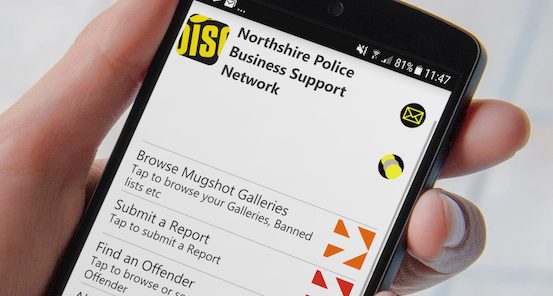
Intelligence@Work utilises Disc itself (of course!) to share information with its members, each of whom can access it direct from their existing Disc App or Desktop.

Intelligence@Work provides:

  • Relevant news and comment about low-level business crime and ASB in general;
  • Information about other business crime reduction schemes, and their work (and not just Disc customers);
  • Useful, practical information from third-parties, such as the ICO, the Home Office, and other organisations;
    everything
  • Everything about Disc, including all our Guides, Manuals, Factsheets, Model Documents etc, all downloadable if and when members need them.
  • The Intelligence@Work eNewsletter, emailed to all readers every month, to keep them up-to-date with everything that’s been added in the previous 28 days.
  • If you’d like to access Intelligence@Work – whether you’re a Disc customer or not – or if you’ve got something you think should be included in it, contact us now.

    Driving down low-level crime and ASB in Gloucester and beyond

    Driving down low-level crime and ASB in Gloucester and beyond

    Set up in 2014, Gloucester City Safe is one of the UK’s most successful – and certainly the most studied – business crime reduction schemes in the UK. And at the heart of its success is Disc.

    From scratch, Gloucester City Safe has grown both geographically (it now covers the neighbouring town of Stroud) and functionally (for example it played an important part in delivering local response during the Covid emergency).

    City Safe is a collaboration between the city’s local retail and leisure sector businesses, Business Improvement District, police and councils, all of which share the aim of ensuring everyone can live, work and socialise in Gloucester free from harm or intimidation, and, since 2016, in neighbouring Stroud too.

    The scheme has been outstandingly successful in achieving that aim, as evidenced by research carried out by Gloucester University’s criminology students who have studied City Safe’s activities and its impact on low-level business crime and ASB over more than five years.

    Exclusion Scheme

    Key to its success has been City Safe’s exclusion scheme. Steve Lindsay has run City Safe and its exclusion scheme since 2018: “Our members share information about local trouble-makers in the form of incident reports. If an individual is reported for a qualifying incident, they are given a Yellow Card, and if they’re cited in a further incident within 12 months, they get another one.

    “Usually that means we visit them and have a serious conversation” says Lindsay, who joined City Safe after 20 years as a business operations manager for a large IT company. “It’s an opportunity to get them to understand the implications of what they have done and what will happen if they carry on offending. Just having this contact with them is often all they need to get them to improve their ways. But if they offend again, that’s when they’re excluded from members’ premises.

    Exclusion from the premises of all scheme members across the city (a separate but identical scheme covers Stroud) is a substantial sanction. “If they want to go shopping, or fancy a drink, they’ll have to do it outside the City Centre – or Stroud – for the next 12 months”.

    The exclusion is a civil sanction, administrated and operated entirely independently of police, based on members’ common law right to deny access to their premises to anyone who represents a threat to their property, or staff, or customers. But for persistent offenders who still don’t get the message – or refuse to hear it – City Safe works with police to apply for Criminal Behaviour Orders, a breach of which constitutes a criminal offence.

    The scheme is strongly supported by the police and local councils. “They recognise that we’re effective at addressing and reducing local low-level business crime and ASB – of which there is a great deal in any town or city-centre”, says Lindsey. “We work with police to help identify prolific, sometimes professional offenders, on whom they can concentrate their resources to bring them to justice. Working with us, police and councils can focus their resources more effectively on more prolific offenders or those with profound behavioural problems”.

    City Safe provides a range of options to offenders who wish to choose them. It liaises closely, for example, with Young Gloucestershire, an enterprise supporting disadvantaged young people who are facing challenges in their lives, and with Restorative Gloucester, a group of community organisations that offer opportunities to participate in ‘restorative justice’.

    Under the microscope

    City Safe is certainly the most studied business crime reduction scheme in the UK.

    Since 2015, students at the University of Gloucestershire have been studying it with the aim of answering two key questions: does the scheme help reduce low-level crime and, if so, by how much?

    Their work shows that almost four out of every five first-time offenders do not go on to full exclusion. Of those that do, one-in-three doesn’t re-offend again. And the study shows, interestingly, that offenders that do re-offend tend not to do so in the premises in which they had previously been reported. You can read a summary of the research here.

    City Safe and Disc

    From its inception in 2014, Gloucester City Safe has used Disc. “We have to provide a cost-effective service to our membership,” says Lindsay, “and Disc is essential to that. It means that I can support the entire scheme – and build its membership – as well as maintain a constant two-way flow of information between our ever-growing membership and police. I simply couldn’t do it without Disc”.

    Disc also provides ‘direct-to-police’ crime reporting allowing members to escalate incidents into Crime Reports, emailed direct to police. Reporters receive a Crime Report number more quickly, and without the need to phone-through to police 101. The system is heavily used, and usage is growing – even through Covid. In 2020, City Safe’s Disc system handled over 32,000 logins, 1,331 incident reports were submitted into the system of which 162 were escalated as crime reports to police; 2021 stats show further growth.

    “Obviously, running an exclusion scheme is a delicate business; we’re dealing with difficult – sometimes vulnerable – individuals, and we have a duty to them as well as to our members. Apart from enabling us to manage incidents and the exclusion scheme itself, and sharing current awareness among members, Disc helps us operate in strict compliance with all-important data protection law”.

    Disc has been designed from the first to be ‘compliant by design’ ensuring that information is processed compliantly. “At the end of the day, it’s not Disc’s responsibility to ensure compliance – it’s our own” says Lindsay. “But Disc provides the technical security that we need, plus many built-in features which makes compliance easy. The people behind Disc also provide a full set of ‘model documents’ which has made it easy to develop our own mandatory documentation and to secure full accreditation to the National Standards criteria managed by Secure by Design.

    “Disc is crucial to us: it looks after so many of the procedural elements of the work, so it leaves more time for the interpersonal stuff that is so crucially important”. During Covid, the local City Protection and Neighbourhood Policing teams also used City Safe’s Disc to manage Covid-19 non-compliance, supporting local Covid Marshalls across all six local council districts throughout Gloucestershire.

    Steve Lindsay says he’s looking to expand the use of Disc, hopefully county-wide, in the near future to take advantage of the scalability and adaptability of the cloud-based system.

    Gloucestershire’s Police & Crime Commissioner (PCC) Chris Nelson has set out plans to bring all six districts across the county into the scheme, as well as to develop rural schemes to support more remote communities.

    According to Chris Nelson, “There is hard evidence over a long period to support the claim that Gloucester has the best city-centre business crime reduction partnership in the country, and I would like it to be said about the whole of Gloucestershire as well. Always striving to be better than we are drives up standards, and that is my aim.
    “I have promised a zero-tolerance approach to anti-social behaviour because it’s what the public tell me they want. Disc’s role in providing instant communications and information can play an important part in delivering that. Gloucester, Cheltenham [another Disc user] and Stroud are great examples of what can be achieved through partnership working and I am committed to working with all six districts across the county to reducing low level crime and anti-social behaviour throughout Gloucestershire”.


    New service from Disc: GDPR compliance documentation

    New service from Disc:  GDPR compliance documentation

    Helping new Disc customers to ensure their systems are set up in a compliant manner is part of the Disc implementation process. Now we’ve made this service available to non-customers too…

    Business crime reduction schemes should know that compliance with GDPR is essential. Yet too many still lack key obligatory documentation.

    We’ve long provided advice to all-comers on the subject: anyone can view our video webinar on Data Protection Law and Business Crime Schemes (watch it here) which should be obligatory viewing for Data Controllers of any organisation that processes personal data for the purposes of the prevention and detection of unlawful acts, or manages an exclusion scheme.

    And we have a full set of ‘Model documents’ for customers and non-customers alike who wish to put together their own GDPR compliance documentation (contact us to request your own set).

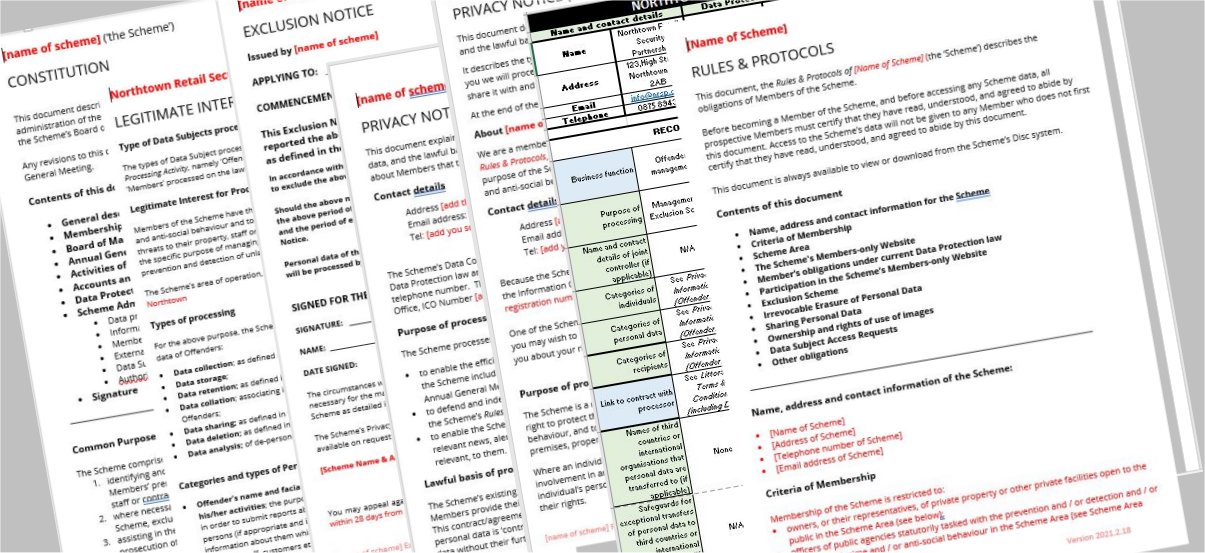
    Schemes that don’t have the necessary documentation in place – privacy notices, legitimate interest assessment and a record of processing activity – are effectively breaking the law and laying themselves open to complaint by Data Subjects – and their no-win, no-fee legal advisers.

    At Disc we’re proud to call ourselves GDPR geeks. So we’re now offering not only our Model Documents to all-comers (free of charge, as always) but, for those who want to make the most of our expertise on the subject, we’re able to produce a full set of the necessary documentation specifically tailored to their own schemes for an all-in fee of £250. Since launching the service in May 2021, 18 schemes have already taken up the offer.

    For more information on this service contact us now.

    Ten new Disc implementations – from Penzance to Northumbria

    Ten new Disc implementations – from Penzance to Northumbria

    Since our previous eNewsletter in May, we’ve implemented ten new Disc systems including three in Cornwall and our first for Northumbria Police, to support a new business crime reduction scheme in South Tyneside.

    From Cornwall to Northumbria…

    Truro, St Austell and Penzance BIDs have each signed up with Disc to reduce low-level crime and ASB in their own areas – and link together across the county for cross-Disc information sharing. “We’ve been looking to establish Disc in Cornwall for some time” says Littoralis’ Charlie Newman, “so we’re delighted that three have decided to adopt Disc!” These join three other Disc systems already serving Exeter, Plymouth and Newtown Abbot, making a total of six Disc systems across the Devon & Cornwall policing area.

    At the opposite end of the country, Northumbria Police has chosen Disc as its information-sharing platform for a new project supporting businesses in its South Tyneside district. Disc will initially be used to support retail crime reduction in South Shields. The hope is that it will extend its coverage across the wider South Tyneside area and ultimately, if the pilot goes well, across the whole force area.

    “Northumbria policing area is unique” says Charlie Newman of Disc “in that the bulk of its population is in the major metropolitan areas of Newcastle, Gateshead and Sunderland, while the bulk of the area is across Northumberland itself – one of the must rural counties in the UK. Obviously we’re optimistic that, in time, the rural variant of Disc can be deployed here to address the special needs of rural crime reduction, as it is already being used in other rural areas in the UK.”

    Burnley and West Brom

    Burley BID in Lancashire and West Bromwich BID in the West Midlands have both chosen Disc to support their levy-payers. Burnley BID, managed by third-sector management company Groundwork, has invested in two linked Disc systems to support respectively its retail and night-time economies. These join existing Disc systems in Blackburn, Blackpool and Preston – creating the potential for a powerful information-sharing network across the Lancashire policing area.

    West Bromwich Town Centre BID is the seventh Disc customer in the West Midlands policing area, along with Coventry, Kings Heath, Soho Road, Solihull and Wolverhampton BIDs, and the Bullring & Grand Central shopping malls which dominate the retail centre of Birmingham. West Brom will be using Disc to support the work of its Town Ambassadors who patrol the BID area six days a week and will enable the BID to support an Exclusion Scheme for its retail levy-payers.

    More Disc for Mitie

    Mitie, one of the UK’s leading security companies, has invested in its own Disc system to help share low-level crime and ASB intelligence among its customers. Its client Hammerson, the UK’s largest shopping centre company, already uses Disc to manage Exclusion Schemes in each of its malls across the country; Mitie’s investment in its own Disc system means it can access that information too, to help not only Hammerson but also its other retail clients.

    New night-time systems for existing customers

    “It’s a great vote of confidence in Disc when existing customers invest further in the product” says Charlie Newman, “which is exactly what Luton and Eastleigh BIDs have done”. Both have been supporting their retailers with Disc for some years and have now extended their role to support their local night-time economies. Compliance with data protection obligations has led each to invest in separate systems for the purpose. For them, a second Disc implementation proved more cost-effective than converting their existing Disc systems into a multi-scheme Disc SC system. Read more about Disc SC here.

    New Resource Packs to help new schemes

    New Resource Packs to help new schemes

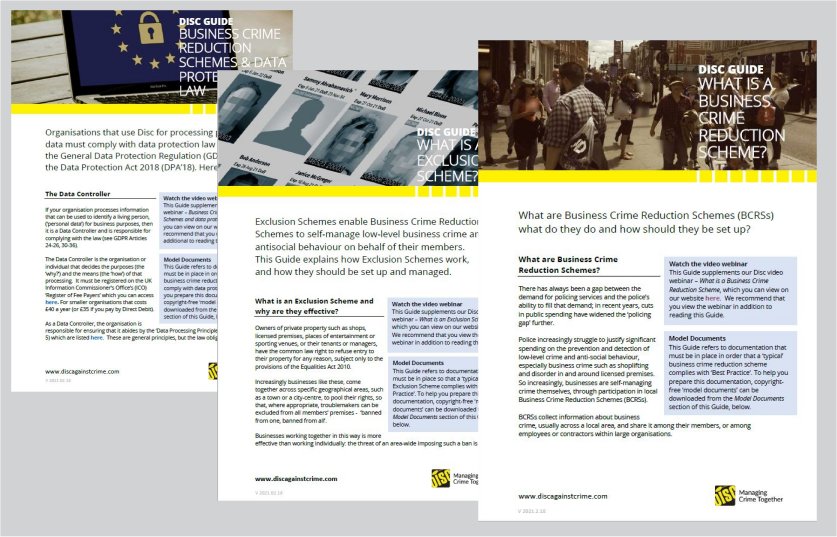
    More and more businesses are working together to ‘fill the policing gap’. Now we’ve developed three brand new Resource Packs to help them take the first critical steps. Whether you’re looking to set up a Business Crime Reduction Scheme (BCRS), implement an Exclusion Scheme, or want to understand how such schemes must comply with data protection law, make use of these free resources.

    “We’ve had two free-to-view video webinars on our website since before the advent of GDPR in May 2018” says Disc’s Charlie Newman. “We started with our guide to data protection, and then added our webinar on how to set up a BCRS. Since then more than 400 individuals have viewed the videos. A number of attendees went on to set up new BCRSs, which is great of course.

    “Last year we decided to revise the webinars, and develop a set of additional supporting materials for each of them which we’re calling ‘Resource Packs’. Now viewers of each webinar can request a PDF Guide which covers the same subject but goes into more detail, and includes links to useful third party resources as well as to ‘model documents’ – invaluable as the basis for producing necessary documentation.

    “And we decided to launch a new Resource Pack, complete with webinar, supporting Guide and Model Documents, on how to set up and manage an Exclusion Scheme.

    “We believe these Resource Packs – which are free for all-comers – can help fill a growing demand for more information on setting up Shopwatches, Pubwatches and Business Crime Reduction Partnerships” says Newman.

    You can view the webinars free of charge, following which you can request your own copy of the relevant Guide and copyright-free Model Documents, on the Disc website:

    • click here to view What is a Business Crime Reduction Scheme? How do they work?  How do you set one up?;
    • click here to view What is an Exclusion Scheme? How do you set one up?  How do you manage them?
    • click here to view Business Crime Reduction Schemes and Data Protection Law; the legal basis; GDPR; key documentation explained

    Harnessing the power of county-wide Disc Networks to drive down crime

    Harnessing the power of county-wide Disc Networks to drive down crime

    In over 500 town- and city-centre crime reduction schemes across the country Disc enables tens of thousands of local businesses to share information about low-level crime, ASB and prolific offenders. But Disc systems can network together to share information across a county or metropolitan area mapped onto police force areas.

    Already county-wide Disc Networks represent a step-change in driving down low-level crime across the UK.

    Linking together into county-wide Disc Networks means local Administrators can easily and instantly share important Alerts and other current awareness and identify ID-Soughts and prolific offenders. Each participating Administrator stays entirely in control and can choose which other systems to connect with, how to process information received from them and whether or not to share their Offenders’ personal details with them.

    And countywide or metropolitan Disc Networks like these can link directly to police, to help them work more effectively to close the ‘policing gap’.


    What are the benefits of linking Disc systems together?

    Connecting Disc systems across county or metropolitan areas ensures that all schemes in the area, especially those operating under the same police force’s Information Sharing Agreement, forge close links with each other to drive down low-level crime and ASB.

    Working together in this way, the individual Disc-enabled schemes enhance their own effectiveness – and make them essential links in an organised county network. Connecting Disc systems together into Disc Networks makes it easier for the police to access the wealth of intelligence that crime reduction schemes and other local organisations such as BIDs share with their members. Higher levels of collaboration between police and the schemes further enhance the schemes’ effectiveness in combatting low-level crime and, in turn, the level of support available from police and their Police & Crime Commissioners.


    What information can be networked and shared?

    Cross-Disc publishing keeps local businesses continually – and more quickly – informed. It helps Administrators maximise the flow of useful information to their Members: the more they receive, the more they participate in their local Disc system.

    So right across the Disc Network, participating schemes can share latest news, Alerts, documents, information about up-coming events and ID-sought images. The sharing process is simple – just one click is all it needs.

    Disc Networks also enable each participating Administrator can allow other Administrators in their network to access their databases to search for Offenders known to more than one Disc system and who therefore are travelling, possibly prolific (in police language – ‘Level Two’ Offenders).


    GDPR compliance

    Like every other aspect of Disc, Disc Networks are GDPR compliant ‘by design’. Administrators as Data Controllers are always in control of who they share their data with: peer-to-peer sharing enables each Admin to decide who they wish to share with within the Disc Network.

    Naturally, as always, sharing of personal data in this way will need to be covered by each scheme’s own compliance documentation, specifically their Legitimate Interest Assessment and relevant Privacy Notices.

    Another example of Disc’s policy of ‘compliance by design’ enables Administrators to search across a Disc Network using its Cross-Disc Offender-Matching function at the same time as avoiding any question of ‘fishing’ of personal data – that is searching through shared personal data on the off-chance that it may be relevant.

    Disc Networks require Administrators to search only on a ‘reference’ Offender within their own Disc databases. And in Disc, ‘Close Matches’ are based exclusively on the Offender’s relevant characteristics, ensuring the data shared is proportionate to the search.


    You can read about county-wide Disc Networks in our factsheet here. Or contact us to discuss how we can help you connect with other Disc Networks across your own county or metropolitan area.

    Self-managing anti-social behaviour to make a difference

    Self-managing anti-social behaviour to make a difference

    For almost a year now, high street businesses have faced unprecedented challenges.  Covid has closed tens of thousands of retail premises resulting in a temporary decline in shoplifting, while the virtual closure of the night-time economy has reduced the level of associated anti-social behaviour (ASB).  Yet overall, data show that lockdowns, job losses, business closures and social isolation has stoked a new wave of ASB – and shifted it onto the streets of our towns and city-centres.

    Anti-social behaviour falls into four categories:

    • Personal: when a person targets a specific individual or group;
    • Nuisance: when someone causes trouble, annoyance or suffering to a community;
    • Environmental: when behaviour affects public spaces or buildings;
    • Covid-related: we should (hopefully only for the time being) include a new type of ASB: non-compliance with Covid restrictions.


    How does ASB affect local businesses?

    ASB impacts local businesses as much – perhaps more – than residents.  Public-facing businesses such as retailers, licensees, and sporting venues suffer not only from the fear, or impact, of violence, but also concern for workers and customers’ health and potential business property damage and the cost of repair.

    Research shows a growing demand from local business owners for police forces to deal with anti-social behaviour. Unlike shoplifting, ASB is highly visible and often directly affects customer footfall. Business Improvement Districts (BIDs) can help protect local businesses from low-level crime and ASB and naturally their levy payers want to see action.

    ASB affects both daytime and night-time economies and often crosses over between the two. Alcohol-fueled or drug-related ASB, for example, poses challenges for both daytime retail and night-time hospitality venues.  Hence the growth of local Shopwatches and Pubwatches over recent years, as well as larger Business Crime Reduction Partnerships.

    It is vital to ensure crime information is shared between businesses who open during the day and those that open at night – but Shopwatch and Pubwatch schemes often run independently of each other so there is little sharing of information between them.


    How can Disc help?

    With Disc, schemes like these can work entirely independently, while sharing information between them (and their members) efficiently, effectively – and compliantly.

    Disc also helps them work more closely with police, self-managing their own low-level crime and ASB but also identifying prolific offenders so that the police and other public agencies can focus their limited resources on pursuing them through the conventional criminal justice process.

    This is ‘filling the policing gap’. Despite rising incidents of ASB, they are woefully under-reported to police. Lengthy delays on the 101 police non-emergency helpline and the belief that police won’t follow up such reports explains a lot.

    Disc is a game-changer, enabling local businesses not only to fill the policing gap, but also enabling police to target their limited resources where they can have the biggest impact – on the prevention and detection of more serious crimes.

    Disc enables effective information-sharing and through the Alert system, emerging issues and developing prolific offenders can quickly be identified and dealt with immediately. Police benefit through the gathering of evidence for a CBO, receiving information about ID-Soughts and focusing their resources on combatting prolific offenders.

    Most importantly, all of this information can be shared securely and processed in full compliance with Data Protection Law and GDPR, including the processing of young persons’ data. Disc has been developed with ‘compliance by design’ at its heart, ensuring information security is embedded throughout its data-gathering processes.

    Disc offers a win-win-win solution for crime reduction schemes, BIDs and police forces;  read more about how Disc works here.

    To find out more about how Disc, or to book a demonstration of the system, please complete the enquiry form and we will be in touch!

    Disc continues growth despite Covid: November/December 2020

    Disc continues growth despite Covid: November/December 2020

    Local business crime reduction schemes have been confronted with unparalleled challenges since the advent of Covid.  Yet new schemes, including Shopwatches and Pubwatches, continue to be set up while existing ones continue to develop, with new Disc systems and upgrades to Disc ‘SC’ (for Segregated Content).


    New county-wide scheme for Derbyshire

    Chesterfield Business Crime Reduction Scheme, managed by East Midlands Chamber of Commerce, has upgraded its existing Disc system to Disc ‘SC’ as part of its plans to deploy Disc across the entire county. Re-branded as the Derbyshire Business Crime Reduction Partnership, the scheme is well on its way to supporting towns throughout the county and Disc SC will enable it to support multiple schemes under one Disc system.


    Fifth Disc system for Telford & Wrekin

    West Mercia Police has invested in a further Disc system for its local policing area of Telford & Wrekin.  The police-administrated Disc system covers Great Dawley and joins (and links to) four other Disc systems in the area serving Wellington, Telford – retail and night-time – and Oakengates.


    Two more shopping centres in Scotland

    The UK’s largest shopping centre operator has confirmed the acquisition of two more Disc systems to add to its existing eight implementations.  The new systems, deployed at the company’s two Scotland-based centres, means that Disc now supports its entire portfolio.  Each system is locally administrated and supports local exclusion schemes within each centre, yet they are also linked together to help identify travelling offenders. We’re also working with the customer to link each of its own Disc systems with others in the same areas, so they can work together to share local alerts and other current awareness as well as the identities of relevant offenders.


    Two new Disc systems for the Midlands

    Highly regarded Business Crime Reduction Partnerships Leicester City Watch and Mansfield Business Crime Partnership have adopted Disc. Leicester City Watch is one of the longest established schemes of its sort in the UK; Mansfield Business Crime Partnership is managed on behalf of its levy-payers by Mansfield Business Improvement District.   Both have decided to migrate from existing information-sharing systems to Disc.


    New Disc SC system for Gloucestershire Safe

    Gloucester City Safe is a long-established Disc customer. Now Gloucestershire County Council has chosen City Safe to set up and manage a separate Gloucestershire Safe scheme based on a new Disc SC system to co-ordinate local government response to the Covid-19 pandemic throughout the county. The system has been deployed to support the county’s response to the pandemic by enabling efficient, effective sharing and recording of relevant information and to brief the county’s Covid-19 Marshals.


    More upgrades to Disc ‘SC’

    Our new Disc SC (for ‘segregated content’) upgrade is being adopted by more and more existing customers, enabling them to deploy multiple crime reduction schemes, while ensuring ongoing compliance with GDPR obligations. The last two months have seen customers including Cardiff Against Business Crime, Hastings Area Business Crime Reduction Partnership, Northamptonshire Business Crime Partnership, Norwich BID, Southampton Business Crime Partnership and Skipton Crime Reduction Partnership move to Disc SC.


    If you’d like to know about Disc SC and whether it is a suitable option for your own scheme, contact us for more information.

    Self-managing low-level business crime – with the police.

    Self-managing low-level business crime – with the police.

    Reduced budgets – and now the added challenge of Covid-19 – have forced police to concentrate their scarce resources where they can be most effective.

    For retailers and licensees across the UK this has meant less police engagement in low level business crime such as shoplifting and anti-social behaviour around the night-time economy.

    While police continue to urge local retail businesses and licensees to report such incidents to them, the perception is that they won’t follow them up.

    Unsurprisingly, as a result there is substantial under-reporting of low-level business-related crime and ASB – and a growth in local business groups which enable their members to manage their own local crime problems without recourse to the police.


    Business crime-reduction schemes: self-management of low-level crime

    Today, around the country, thousands of independent, business-led shopwatches, pubwatches and other business-run crime reduction schemes gather information about local troublemakers and exclude the most troublesome from their premises.

    Effectively they’re self-managing the crime and ASB of which they are victims.

    Research shows schemes like these really work.  Typically, where they manage local exclusion schemes, just one out of five first-time offenders go on to re-offend; of those that do, half don’t offend a third time.

    Clearly such schemes don’t just benefit their members – they also serve the wider society too, by helping first-timers back on the straight-and-narrow without involving the police or the criminal justice system.

    The police are major beneficiaries of such schemes too.  While the schemes look after much low-level crime and ASB (especially in town- and city-centres) police can more effectively focus their resources on more serious crimes and more prolific offenders.

    But there’s much more for both the police and the schemes here: the closest possible inter-working between them can generate more benefits still, and important ones too.


    Police and business crime reduction partnerships

    For police, business crime reduction schemes can help them identify and gather intel about the relatively small number of prolific offenders responsible for the great majority of shoplifting and business-related ASB – exactly the ones on which the police want to focus their time and resources.

    They have much to gain, too, by accessing the communication channels that these schemes maintain with their members.  Those using Disc can enable their policing partners to share police news, alerts, documents and information about up-coming local events directly and quickly with a community that is not always easy to reach.

    Disc can also increase the level of crime reporting by members which police encourage.  Scheme members who submit incident reports through Disc in order to support their exclusion scheme can quickly ‘escalate’ them into crime reports and send them, with optional Witness Statements, to the local force’s 101 desk or resolution centre with a click.

    For the scheme’s part, working as closely as possible with local police brings important benefits in addition to helping them pursue prolific offenders through the Courts, perhaps to obtain Criminal Behaviour Orders or custodial sentences:

    • Information sharing agreements: police forces can provide good-quality personal information about local offenders, including names and images; they’ll look for assurances that the schemes they deal with are properly constituted and managed;
    • Joint operations: many local policing teams mount regular high-visibility trawls through local retail and night-time areas alongside scheme administrators, working together to identify known offenders in town and deter them from criminal activity; in some towns and city-centres, officers wear the scheme’s radio handsets to more quickly respond to requests for assistance by members;
    • Staffing and accommodation: some forces provide low-cost (or even free) accommodation for larger schemes that require office space; officers can also participate in the administration of the schemes themselves, for example being sub-Administrators of its Disc system;
    • Serving Exclusion Orders: it is best practice for schemes to serve ‘exclusion orders’ on offenders who have been banned from members’ premises; police can help here – either serving them in custody suites or delivering them to offenders’ homes;
    • Contact Police & Crime Commissioners: every police force has a PCC (the Met has MOPAC) who have authority over policing policy and strategy; most are keen to support business crime reduction schemes in their area – sometimes financially; the closer an existing scheme works with local police the more visibility it will have with these important influencers.


    Police will always attend serious incidents that involve immediate threat, irrespective of the value of any theft involved. But they are the first to admit that low-level business crime and ASB is a long way down their list of priority incidents.

    Business crime reduction schemes provide local business with the tools to self-manage their own low level crime, and reduce its negative impact on their financial ‘bottom line’.

    Working together is to the clear benefit of both – and the closer the inter-working, the greater the benefits for them – and the wider community.


    Find out more

    If you are interested in learning more about self-management of local crime and Disc, please see our website or book a demonstration here.